Space-Saving Desk Decor Accessories for Small Desks
Desk decor accessories for small desks is a category of workspace elements that supports organization, visual clarity, and functional balance within limited surface areas. It focuses on how desk surface constraints influence the placement and role of each item based on footprint, usability, and spatial efficiency. In this context, each desk decor accessory is evaluated through EAV logic where desk surface area, accessory footprint, workspace efficiency, and clutter impact are directly connected. The purpose is not decoration alone but maintaining a structured relationship between usable space and visual order under constraint-driven conditions.
The balance between aesthetics and usable space depends on how strongly desk decor accessories affect overall workspace efficiency on a small desk. When the footprint of accessories increases, available working area decreases, which can reduce visual clarity and interrupt functional zones depending on layout density. This creates a continuous trade-off where compact workspace decisions must account for storage balance and minimal setup conditions. A broader understanding of this structure connects back to general selection logic within desk decor accessories as a unified system before deeper spatial constraints are analyzed in the following sections.
Spatial Constraints and Small Desk Setup Limitations for Desk Decor Accessories
Spatial constraints for desk decor accessories define the physical and functional limits that shape how items are placed on a small desk. The desk surface creates a restricted area where usable zones must be structured to maintain workspace layout stability. Interference between devices, tools, and decor elements can reduce available movement space and affect usability. In this context, constraint mapping explains how desk surface dimensions influence arrangement logic and spatial efficiency outcomes.
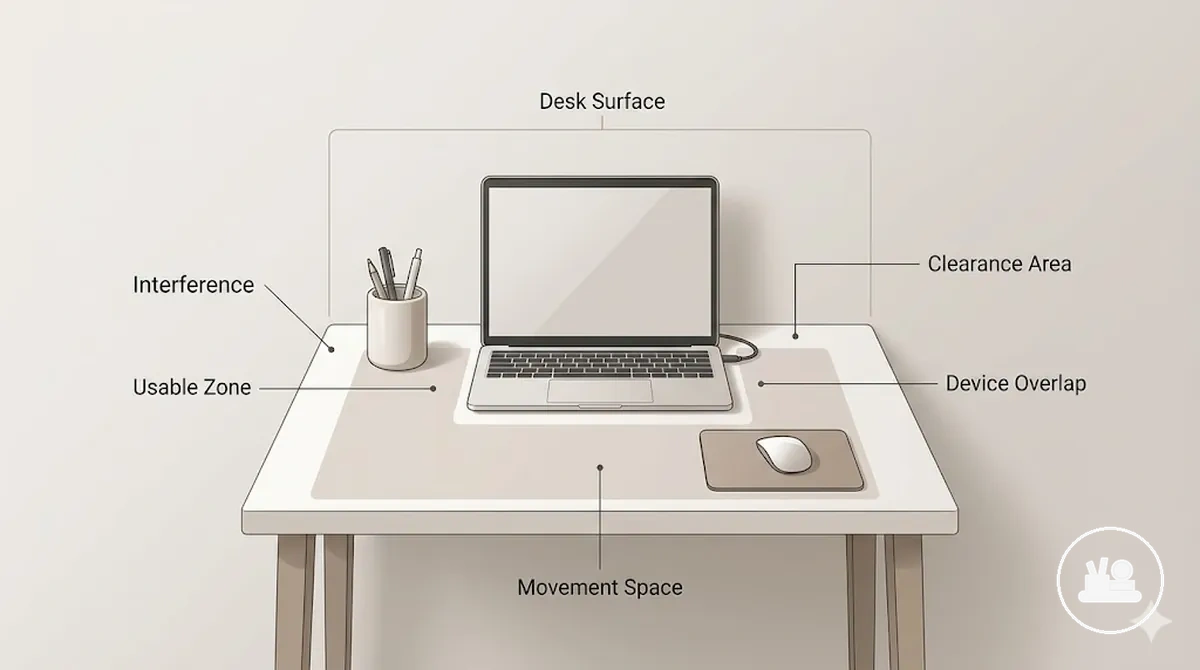
Usable zones on a small desk are shaped by how desk decor accessories interact with functional work areas such as typing space, device placement, and movement clearance. Desk surface width and depth determine how much separation exists between active zones and accessory zones, and this separation may vary depending on setup type such as study desks or compact home offices. Interference occurs when overlapping objects reduce functional clarity or restrict natural hand movement across the workspace. In many cases, workspace layout efficiency depends on maintaining clear boundaries between functional and non-functional areas, although the exact impact may vary by usage pattern.
- Desk surface width, which limits horizontal placement options for desk decor accessories
- Desk surface depth, which affects reachability and layering of usable zones
- Usable zones overlap, where functional tools and decor compete for the same space
- Movement restriction, which reduces comfort during writing or device use
- Interference between objects, which can disrupt workflow continuity
- Constraint mapping accuracy, which defines how clearly layout logic is structured
- Workspace layout density, which influences overall visual clarity and usability balance
Space-Saving Sizing Principles for Choosing Desk Decor Accessories on Small Desks
Sizing logic for desk decor accessories on a small desk refers to the structured evaluation of footprint, proportional scaling, and spatial balance to maintain usability within limited surface boundaries. It defines how each accessory is measured against available desk surface capacity while preserving negative space to avoid functional and visual overload. This principle explains how footprint distribution directly affects workspace clarity, movement efficiency, and layout stability. In most setups, sizing logic acts as the primary control layer for managing spatial density before any placement decisions are made.
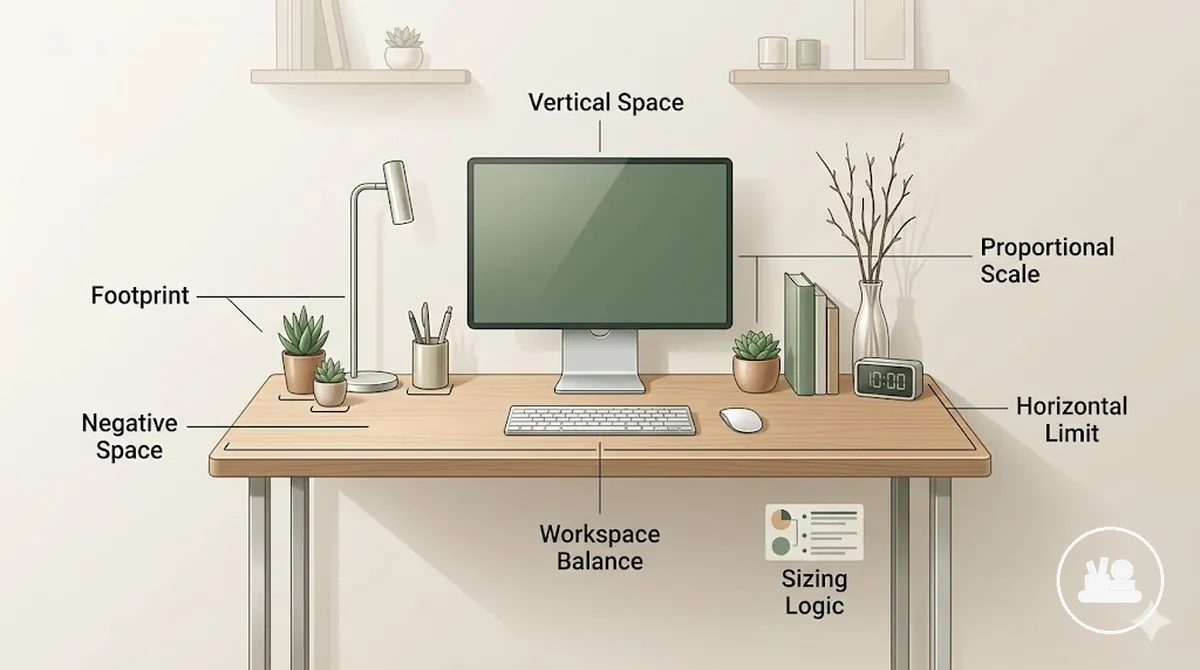
Sizing decisions depend on balancing footprint with usability so that desk decor accessories for small desks maintain workspace efficiency without disrupting functional areas. This evaluation approach is applied within desk decor accessories for small desks using criteria based on proportional scaling, vertical prioritization, and preservation of negative space. Vertical prioritization may become more effective when horizontal space is constrained, although results vary depending on desk layout and usage patterns. The relationship between footprint reduction, spatial trade-offs, and visual density determines whether workspace clarity is maintained or reduced under compact conditions.
| Vertical Sizing Strategy | Horizontal Sizing Strategy |
|---|---|
| Uses upward space to reduce desk surface footprint | Expands across desk surface area, increasing footprint usage |
| Helps preserve negative space in compact layouts | Can reduce negative space in limited desk environments |
| Often improves proportional scaling in tight setups | Depends heavily on available desk width and depth |
| Supports clearer workspace layout in constrained areas | May increase visual density when space is limited |
Vertical and Multi-Layer Storage Solutions for Expanding Small Desk Usable Space
When a small desk reaches its limit in horizontal arrangement, vertical space becomes the main driver for reorganizing desk decor accessories through layered structure and elevation-based planning. In such setups, desk decor accessories depend on stacking logic, tier separation, and wall-adjacent positioning to extend usable desk capacity without expanding the physical footprint. This approach uses elevation and organization zones to reduce surface congestion while maintaining functional clarity across different working areas. The result is a shift from flat distribution toward structured vertical utilization that supports more controlled workspace organization.
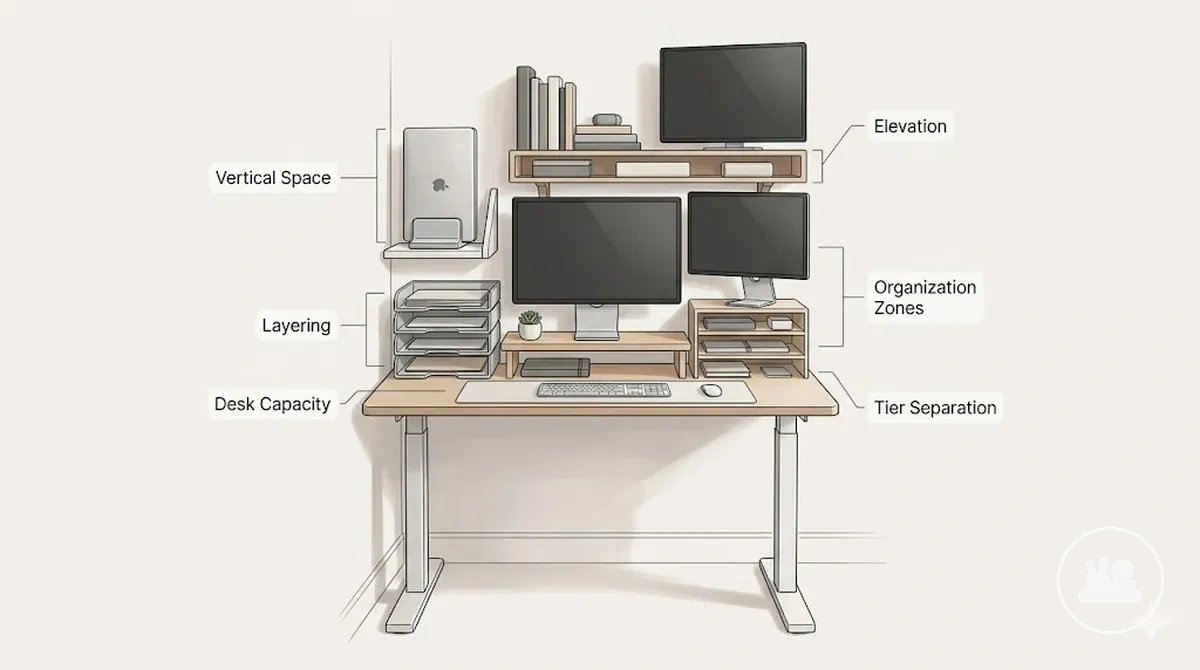
Vertical and multi-layer organization increases desk capacity by restructuring how desk decor accessories interact with elevation, layering, and organization zones within limited surfaces. This method depends on stacking systems, tier separation, and vertical zoning to improve spatial distribution, while a criteria-based approach such as desk decor accessories for small desks helps evaluate when layering becomes structurally appropriate. In many cases, vertical prioritization may improve usability when horizontal space is restricted, but outcomes depend on layout constraints and usage patterns. The balance between layering and surface recovery determines how effectively workspace efficiency is maintained in compact environments.
Flat Layout vs Vertical Layout
- Flat layout spreads items across the desk surface, increasing horizontal footprint usage
- Vertical layout builds upward, preserving more usable surface area below
- Flat structure may reduce negative space in compact desks
- Vertical structure supports clearer organization zones through elevation
- Stacking systems that create layered storage levels
- Tier separation that divides items across vertical levels
- Wall-adjacent placement that shifts load away from desk surface
- Elevation-based zoning that organizes functional areas by height
- Compact layering that improves desk capacity without expanding footprint
- Structured vertical space usage that supports workspace clarity
Compact and Minimal Footprint Desk Decor Accessories for Small Workspaces
Desk decor accessories are defined by a set of core attributes that determine how well they function in constrained work environments. These attributes focus on compact design, multi-functionality, visual weight control, storage integration, and maintaining a minimal footprint. Together, they classify whether an accessory can support organization without overwhelming limited desk surfaces. The entity desk decor accessories evaluate these attributes to ensure they remain suitable for space-sensitive layouts, especially when density increases.
These attributes operate through EAV relationships where each characteristic defines a measurable effect on workspace behavior. Compact design typically supports tighter arrangement patterns that improve overall workspace clarity when space is limited. Multi-functionality contributes to utility density, allowing a single item to serve multiple roles depending on setup conditions. Reduced visual weight can improve perceptual order by limiting visual clutter, although its impact may vary with layout density. Storage integration enables embedded organization behavior that reduces surface dependency, while a minimal footprint helps preserve usable desk space for primary tasks. In high-density setups, these attributes may interact differently depending on how the workspace is structured.
| Attribute | Value | Effect |
|---|---|---|
| Compact design | Space-efficient structure | Improves layout control in limited desk areas |
| Multi-functionality | Multiple usage capability | Increases utility density in small workspaces |
| Visual weight | Low visual presence | Supports clearer and less cluttered workspace appearance |
| Storage integration | Embedded storage behavior | Reduces external clutter on desk surfaces |
| Minimal footprint | Reduced surface usage | Preserves workspace area for core tasks |
Selection Criteria for Choosing Desk Decor Accessories for Small Desk Environments
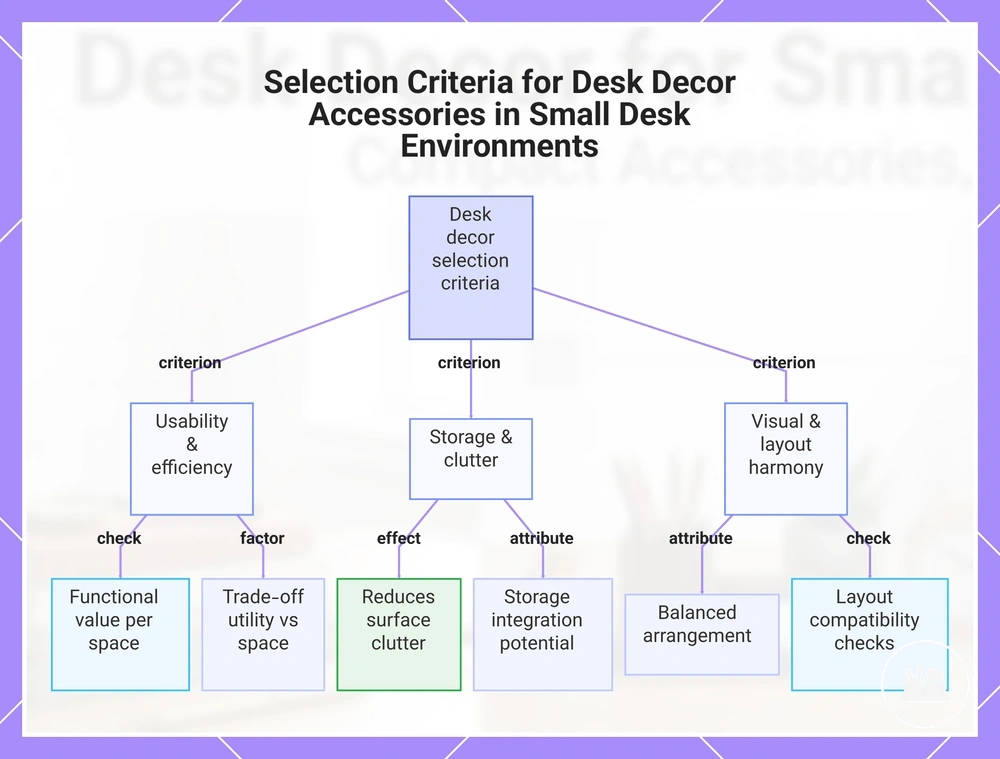
Desk decor accessories depend on selection criteria that balance usability ratio, spatial efficiency, and visual harmony within limited desk environments. The decision framework evaluates how each accessory fits into constrained layouts without disrupting functional workspace flow. These criteria act as structured decision factors that determine whether an item supports organization or increases surface complexity. In small desk environments, selection logic prioritizes measurable balance between utility and space consumption rather than appearance alone.
The evaluation of desk decor accessories follows a structured breakdown of decision factors using usability ratio, storage behavior, and visual harmony as core reference points. Spatial efficiency is assessed by how much functional value an item provides relative to the space it occupies, while storage integration indicates how effectively it reduces surface clutter. Visual harmony contributes to overall workspace clarity by maintaining consistent layout balance, although its impact may vary depending on density levels. Trade-offs often appear between multi-use capability and surface consumption, which affects overall workspace stability. In many cases, compatibility checks between layout planning and efficiency scoring help determine the most suitable configuration under constrained conditions.
- Usability ratio aligned with functional output versus space usage
- Spatial efficiency based on minimized surface consumption
- Visual harmony reflecting balanced workspace arrangement
- Storage integration potential for reducing surface clutter
- Compatibility with existing layout structure and device placement
- Clutter control effectiveness under limited desk capacity
- Utility distribution supporting multi-functional workspace behavior
- Decision factors balancing trade-offs between function and space
This chart shows the main criteria for evaluating desk decor accessories in limited spaces, grouped by usability, storage, and visual harmony.
Overcrowding Risks and Space Efficiency Mistakes in Small Desk Decor Layouts
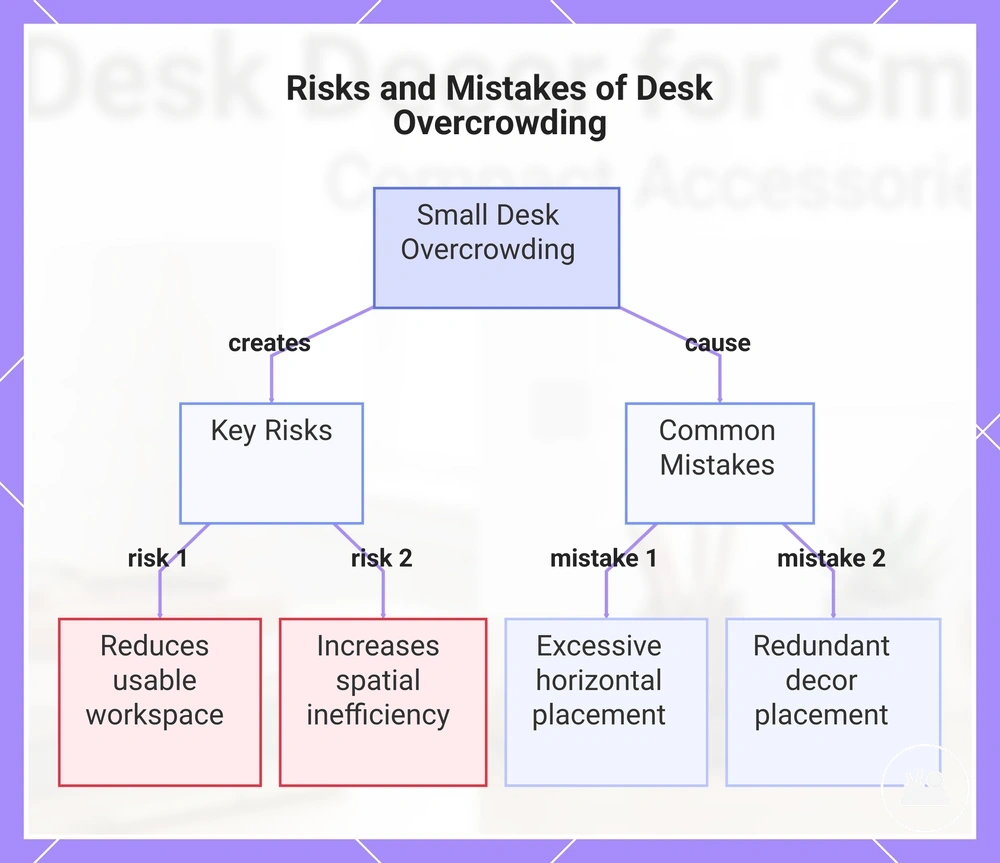
Overcrowding in small desk decor layouts creates a direct clutter risk that reduces usable workspace and increases spatial inefficiency. When desk decor accessories exceed available surface balance, workspace obstruction begins to affect both movement and task clarity. This condition often develops when redundant decor is placed without evaluating functional necessity or spatial priority. As density increases, the desk environment shifts from structured organization toward unstable layout behavior that reduces usability ratio.
Spatial inefficiency in desk decor accessories typically develops through repeated layout mistakes that disrupt functional zoning and visual balance. Overuse of horizontal placement can block key working areas and reduce effective workspace distribution, while redundant decor introduces unnecessary visual load without improving utility. In many cases, clutter risk increases when storage integration is ignored, leading to surface congestion and reduced workspace clarity. The interaction between functional zones and decorative elements becomes unbalanced, creating workflow disruption and limiting practical usability. Compared to optimized layouts, cluttered arrangements show reduced spatial efficiency and weaker structural organization of work areas. These conditions are usually driven by inconsistent decision factors rather than single-point failures.
- Excessive horizontal layering leading to blocked functional zones
- Redundant decor placement increasing visual overload without utility gain
- Workspace obstruction caused by poor separation of work and decor areas
- Surface congestion from uncontrolled object accumulation
- Ignoring storage integration potential in compact layouts
- Unbalanced utility distribution reducing usability ratio
- Overlapping functional and decorative zones creating spatial inefficiency
This chart shows the key risks and common mistakes that lead to overcrowding in small desk decor layouts.