
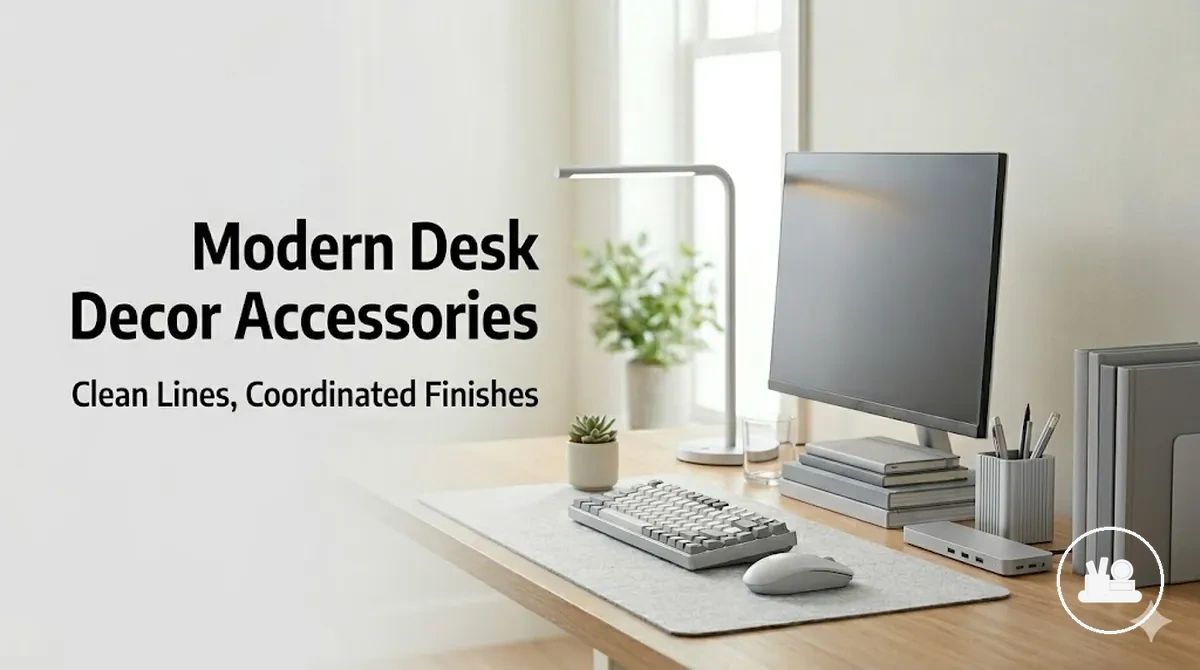
Modern Desk Decor Accessories for Style-Fit Workspaces
Modern desk decor accessories are workspace elements that align clean visual style with practical organization and balanced desk presentation. In a style-fit workspace, modern design usually means coordinated materials, simple forms, and reduced visual noise rather than a crowded display of decorative objects.
This page treats modern desk decor as a decision layer within the broader desk decor accessories context. The focus is not on individual products, brands, or offers, but on how modern accessories can support workspace clarity, visual cohesion, and functional placement when the desk layout, work habits, and preferred aesthetic are considered together.
The next section grounds that scope by defining what modern desk decor accessories include before moving into attributes, accessory roles, materials, configuration choices, and style-fit selection logic.
What Defines Modern Desk Decor Accessories in Contemporary Workspaces
Modern desk decor accessories are workspace elements designed to combine visual simplicity with functional organization. These desk decor accessories are typically identified by clean geometry, neutral tones, and controlled visual density that support an orderly workspace without relying on excessive decoration.
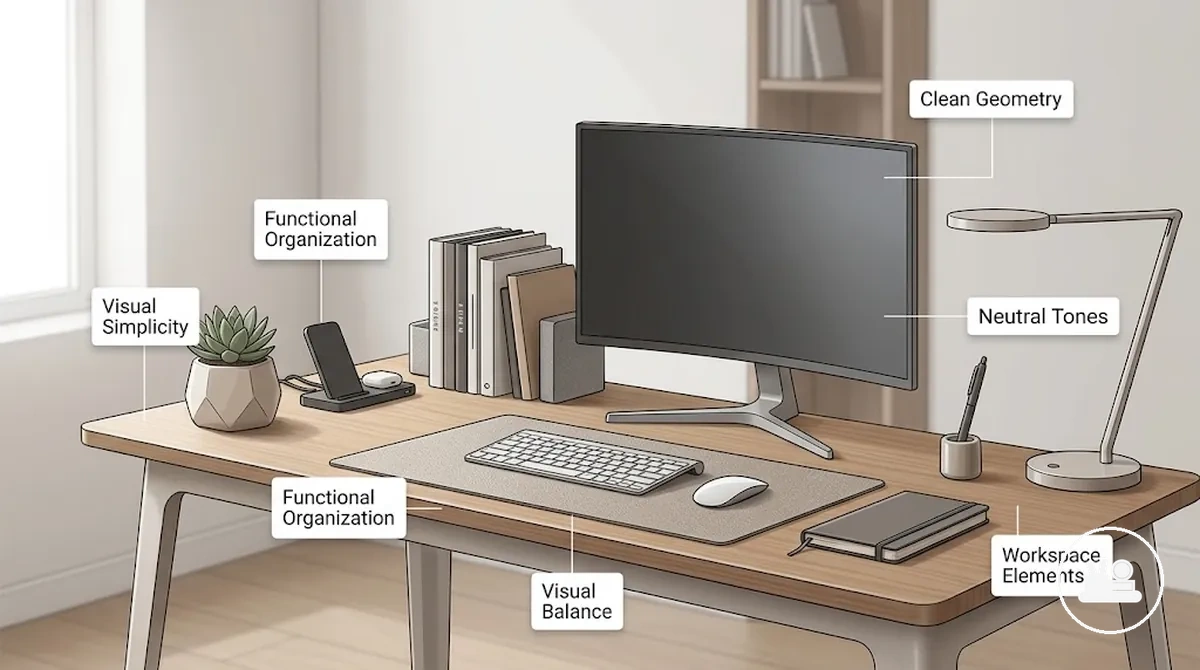
Modern desk decor accessories are defined by design language rather than by a fixed item category. The emphasis is on a consistent visual structure where workspace elements contribute to usability and aesthetic coherence through restrained forms, coordinated finishes, and intentional placement.
Within contemporary workspaces, this definition creates a foundation for understanding how design attributes, material choices, and selection criteria shape a modern workspace environment.
Modern Desk Aesthetic: Clean Lines, Coordinated Materials, and Neutral Color Logic
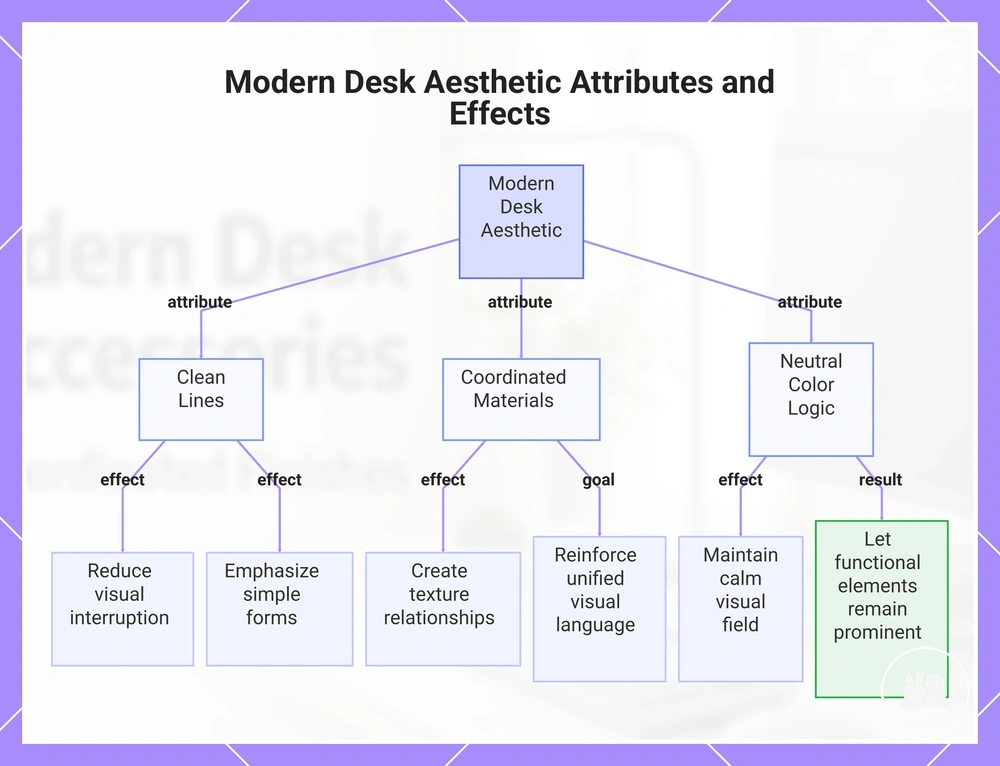
Modern desk aesthetics are shaped by structural design attributes that create visual order through clean lines, coordinated materials, and neutral color logic. These attributes influence how workspace organization, focus, and visual balance are perceived without relying on decorative accumulation.
Clean lines support a modern aesthetic by reducing visual interruption and emphasizing simple forms, consistent edges, and orderly arrangement. A structured visual layout can make workspace elements appear more coherent and easier to navigate visually.
Coordinated materials contribute to aesthetic consistency by creating relationships between textures, surfaces, and finishes. The role of materials, colors, and finishes is to reinforce a unified visual language rather than introduce competing design signals.
Neutral color logic influences visual balance through restrained contrast and controlled emphasis. Depending on the workspace environment and personal preferences, neutral palettes can help maintain a calm visual field while allowing functional elements to remain visually prominent.
This chart shows the three core attributes of a modern desk aesthetic and how each contributes to visual order and workspace focus.
Types of Modern Desk Decor Accessories and Their Functional-Visual Roles
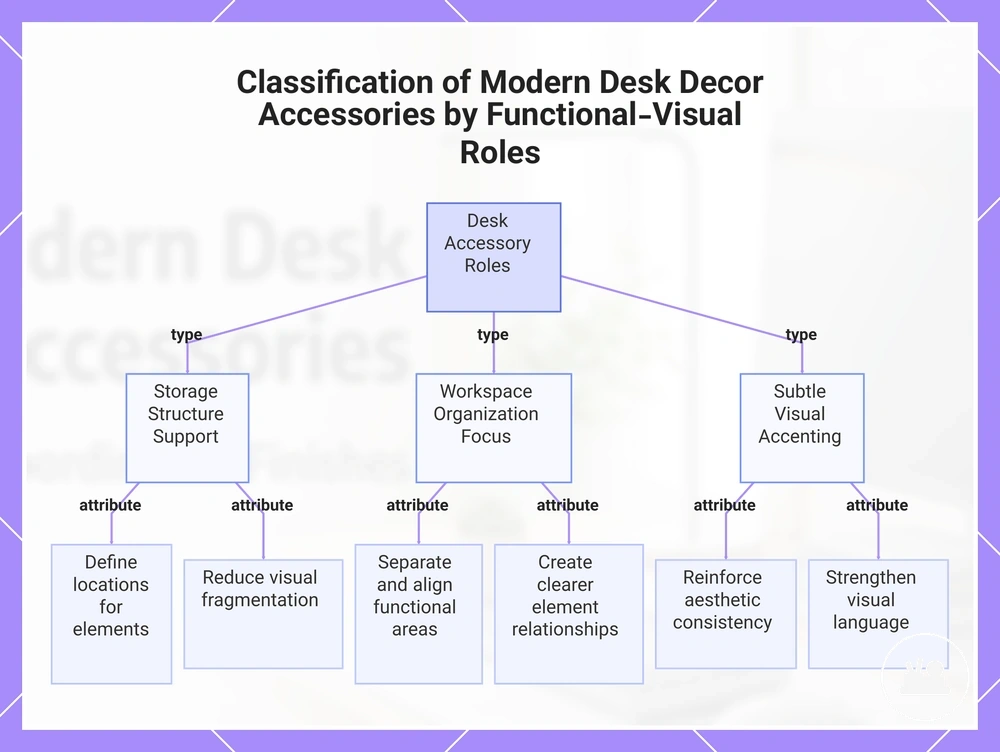
Modern desk decor accessories can be grouped by functional and visual roles rather than by individual item categories. This classification differentiates accessory types according to how they contribute to workspace organization, spatial clarity, and aesthetic consistency within a modern desk environment.
Accessories that support storage structure help establish visual order by defining locations for frequently used workspace elements. Their primary role is to reduce visual fragmentation and support a more intentional arrangement across the desk surface.
Accessories focused on workspace organization contribute to spatial clarity by helping separate, align, or coordinate functional areas. These categories support a clearer relationship between workspace elements, which can make the overall layout easier to interpret visually.
Accessories with subtle visual accenting roles reinforce aesthetic consistency through shape, material coordination, and restrained emphasis. Rather than becoming dominant focal points, they help strengthen the overall visual language of the workspace.
This role-based approach aligns with broader classifications of types of desk decor accessories, where accessory categories are differentiated by their contribution to productivity, visual balance, and workspace structure instead of simple item enumeration.
This chart shows the three functional-visual role groups used to classify modern desk accessories and their key contributions to workspace organization, spatial clarity, and aesthetic consistency.
Modern Desk Accessory Sets vs Individual Pieces: Choosing the Right Configuration
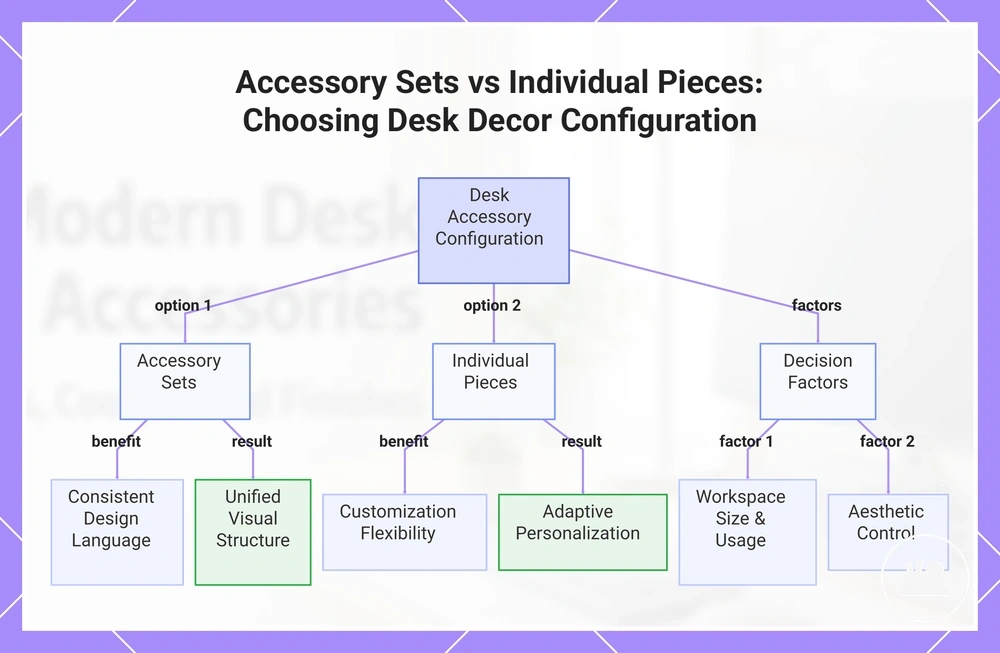
Choosing between modern desk accessory sets and individual pieces depends on balancing visual cohesion with customization flexibility. Accessory sets typically provide a consistent design language across a workspace, while individual pieces allow more adaptive personalization as workspace needs evolve.
Modern desk accessory sets support configuration consistency through coordinated materials, forms, and finishes. This approach can help create a unified visual structure when maintaining a cohesive workspace aesthetic is a primary objective.
Individual pieces provide greater configuration flexibility because accessories can be selected according to specific organizational requirements, available space, or changing workflow preferences. This approach allows the workspace to adapt without requiring a fully coordinated collection.
Workspace size, usage intensity, and desired aesthetic control can influence which configuration is more appropriate. A highly structured workspace may prioritize visual coordination, while a workspace that changes frequently may benefit from selective customization.
For users evaluating how to choose desk decor accessories, the configuration decision is primarily a comparison between consistency and flexibility rather than a choice between superior and inferior approaches.
This chart compares modern desk accessory sets and individual pieces, highlighting their main benefits and key decision factors.
Materials and Finishes in Modern Desk Decor Accessories (Metal, Wood, Acrylic, Matte Black)
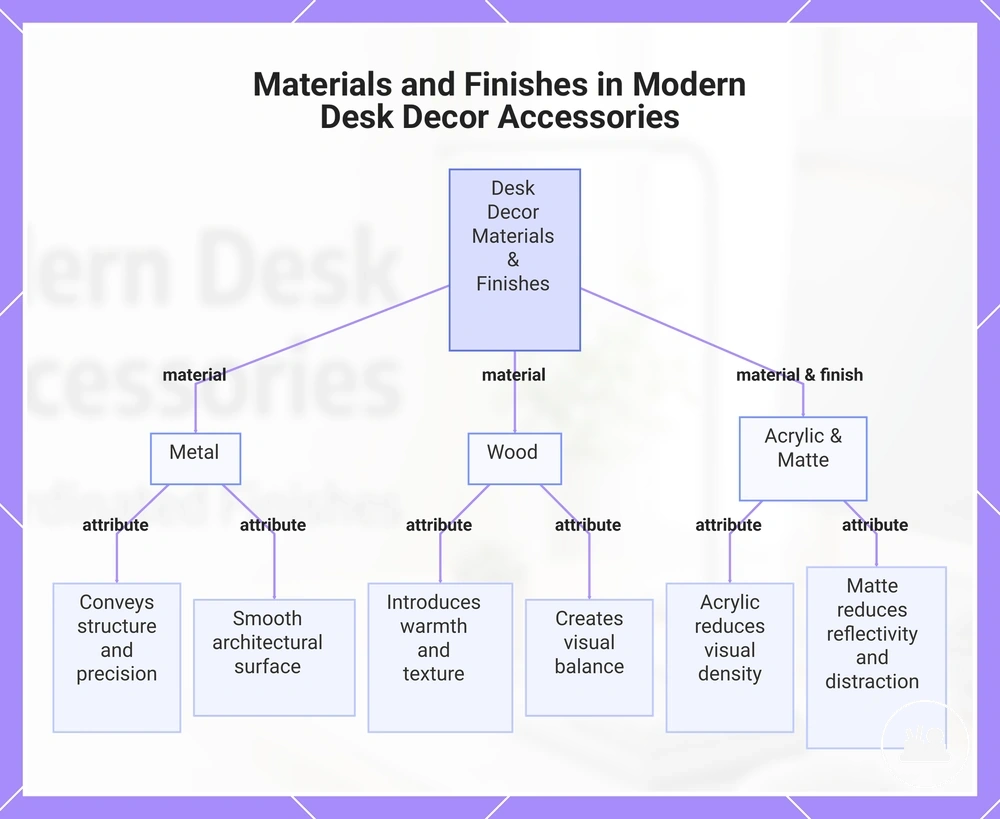
Materials and finishes define both the visual identity and functional character of modern desk decor accessories. Metal, wood, acrylic, and matte finishes differentiate workspace tone through texture, maintenance considerations, and visual presence rather than decorative emphasis alone.
Metal often conveys structure and precision through smooth surfaces, defined edges, and a more architectural appearance. Maintenance requirements can vary by finish, while the material's visual character typically supports an organized and deliberate workspace aesthetic.
Wood introduces warmth through natural texture and surface variation. Its material qualities can create visual balance by softening highly structured environments while maintaining compatibility with modern design principles.
Acrylic supports visual lightness because transparent or translucent surfaces may reduce perceived visual density. This material can help preserve openness within a workspace while still contributing to organization and spatial definition.
Matte finishes reinforce minimal cohesion by reducing surface reflectivity and visual distraction. Within broader discussions of materials, colors, and finishes, matte treatments are often associated with a restrained visual language that complements modern workspace layouts.
Material selection also depends on texture preferences, maintenance expectations, and the intended workspace tone. These considerations help differentiate how materials contribute to long-term visual consistency and overall workspace character.
This chart summarizes how metal, wood, acrylic, and matte finishes define the visual identity and functional character of modern desk decor accessories.
Modern Desk Decor for Home Office and Professional Workspaces
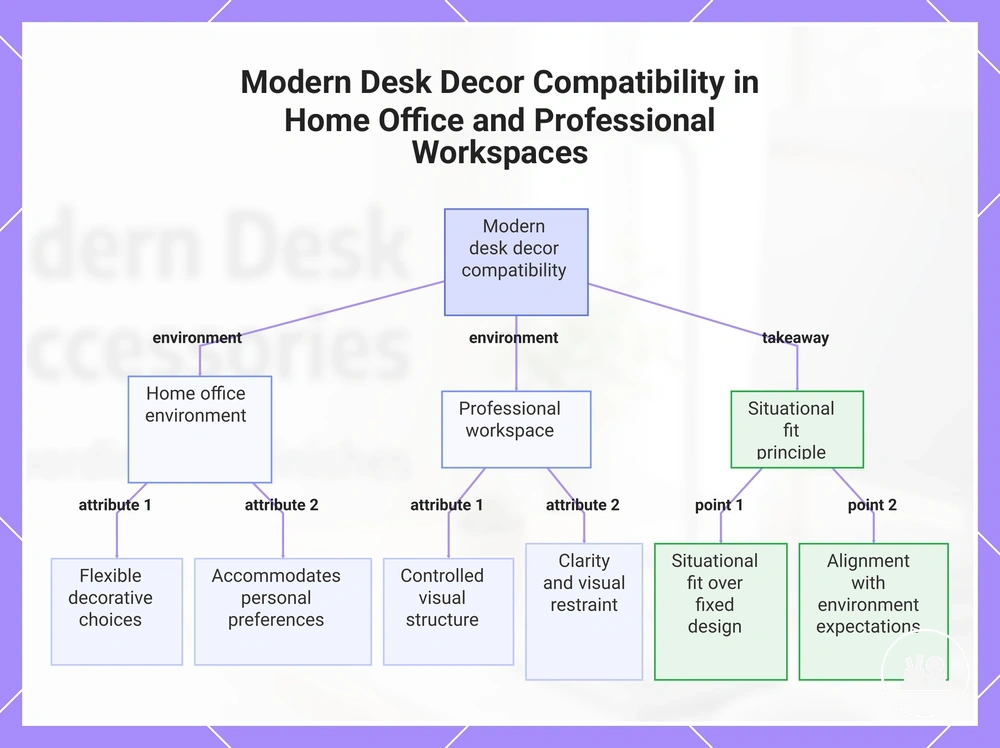
Compatibility between modern desk decor and a workspace depends on how well the accessories align with the environment’s function, level of formality, and expectations for visual restraint. Home office and professional workspace settings often require different approaches to organization, presentation, and personal expression.
Home office environments typically allow greater flexibility in decorative choices, material combinations, and visual variation. Modern desk decor in these settings can accommodate personal preferences while still supporting workspace organization and visual cohesion.
Professional workspaces often favor a more controlled visual structure with reduced visual density and consistent presentation. In these environments, modern desk decor is generally evaluated by how well it contributes to clarity, organization, and a restrained workspace appearance.
The compatibility of desk decor accessories depends on how accessory characteristics correspond to workspace function and behavioral context. Visual prominence, material expression, and organizational roles may be interpreted differently across workplace environments.
Situational fit is usually more important than applying a single design approach. Modern desk decor can support both home office and professional settings when its visual tone and functional role align with the expectations of the specific workspace environment.
This chart compares how modern desk decor aligns with home office and professional workspaces, highlighting key differences in flexibility and visual structure.
How to Choose Modern Desk Decor Accessories Based on Function, Space, and Style-Fit
Selection of modern desk decor accessories depends on balancing function, available space, and visual style so that each element supports both workspace usability and aesthetic coherence. Effective selection is usually guided by how well the accessories align with daily work requirements, desk dimensions, and the intended workspace atmosphere.
Function is a primary evaluation criterion because it determines whether accessories contribute to organization, accessibility, and practical workspace use. Accessories are generally more suitable when their role corresponds to actual workflow patterns rather than purely visual preferences.
Available space influences the appropriate scale, arrangement, and visual density of accessories. Larger work areas may accommodate broader configurations, while smaller desks often benefit from selections that preserve surface openness and maintain visual clarity.
Style-fit focuses on alignment between materials, finishes, forms, and the overall workspace character. Visual coherence is typically achieved when accessory attributes support a consistent design language rather than introducing conflicting visual signals.
Selection criteria can be evaluated more effectively through the broader category of desk decor accessories and the considerations involved in choosing a desk decor accessory set. Considering function, space, and style together usually provides clearer decision support than evaluating any single factor independently.
Minimal vs Modern Desk Decor Accessories: Overlap, Differences, and Use-Case Fit
The choice between minimal and modern desk decor accessories depends on workspace density tolerance and the desired visual tone. Both styles share a foundation of simplicity, but they differ in how simplicity is expressed through organization, material emphasis, and overall workspace composition.
Minimal design prioritizes reduction and restraint by limiting visual elements to those considered necessary for the workspace. The focus is often on maintaining openness, reducing visual density, and minimizing non-essential visual presence.
Modern design also values simplicity, but it typically emphasizes structured coordination, material harmony, and deliberate relationships between workspace elements. Rather than focusing primarily on reduction, modern decor often seeks visual cohesion through balanced arrangement and coordinated design attributes.
A clear style distinction can be seen when comparing modern design with minimal desk decor accessories. Minimal approaches generally emphasize restraint and reduction, while modern approaches may allow greater material expression and coordinated visual structure without moving away from simplicity.
Use-case fit depends on how a workspace is intended to look and feel. Environments that favor lower visual density may align more closely with minimal principles, while workspaces seeking coordinated structure may align more closely with modern design. In either case, maintaining visual balance on a desk can help support a coherent workspace composition.
Clutter-Control Principles in Modern Desk Setups Without Losing Aesthetic Balance
Clutter control depends on maintaining a balance between usability and visual structure rather than removing decorative elements entirely. In modern desk setups, effective clutter control is usually achieved through thoughtful spacing, functional zoning, and management of visual density so that the workspace remains both practical and visually coherent.
Spacing is an important criterion because it influences how easily workspace elements can be identified and accessed. When accessories are positioned with adequate separation, the desk may appear more organized while preserving room for both functional and decorative components.
Functional zoning supports clutter control by assigning clear roles to different areas of the workspace. Organizing accessories according to tasks or usage patterns can help create a more intentional arrangement and improve overall clarity.
Visual density should be evaluated according to the number, scale, and prominence of elements present on the desk. A workspace can appear cluttered when too many visually dominant items compete for attention, even if those items remain organized.
A useful boundary for applying these principles can be found in discussions of desk decor without clutter. The goal is guided organization that preserves aesthetic balance and workspace usability rather than strict elimination of decor.
Styling and Arranging Modern Desk Decor Accessories for Visual Cohesion
Arranging modern desk decor accessories starts with balancing spacing, alignment, and functional zoning so that the workspace maintains visual cohesion while supporting everyday use. A cohesive arrangement creates clear relationships between work areas, storage elements, and accent pieces without introducing unnecessary visual interference.
Primary work areas typically benefit from remaining visually distinct from supporting accessories. Separating active workspace functions from decorative elements can improve spatial clarity and help maintain focus within the overall desk layout.
Functional zoning organizes accessories according to their role within the workspace. Grouping storage-related items, work-support elements, and subtle accents into defined areas can make the arrangement appear more intentional and easier to interpret visually.
Alignment strengthens visual cohesion by creating consistent relationships between objects, surfaces, and layout boundaries. Coordinated positioning can reduce visual fragmentation and support a structured appearance without requiring strict symmetry.
Arrangement is most effective when it contributes to visual balance on a desk. The objective is to create a workspace structure where functional and decorative elements coexist with clear spatial organization and controlled visual density.