Desk Decor Accessories: Meaning and Scope
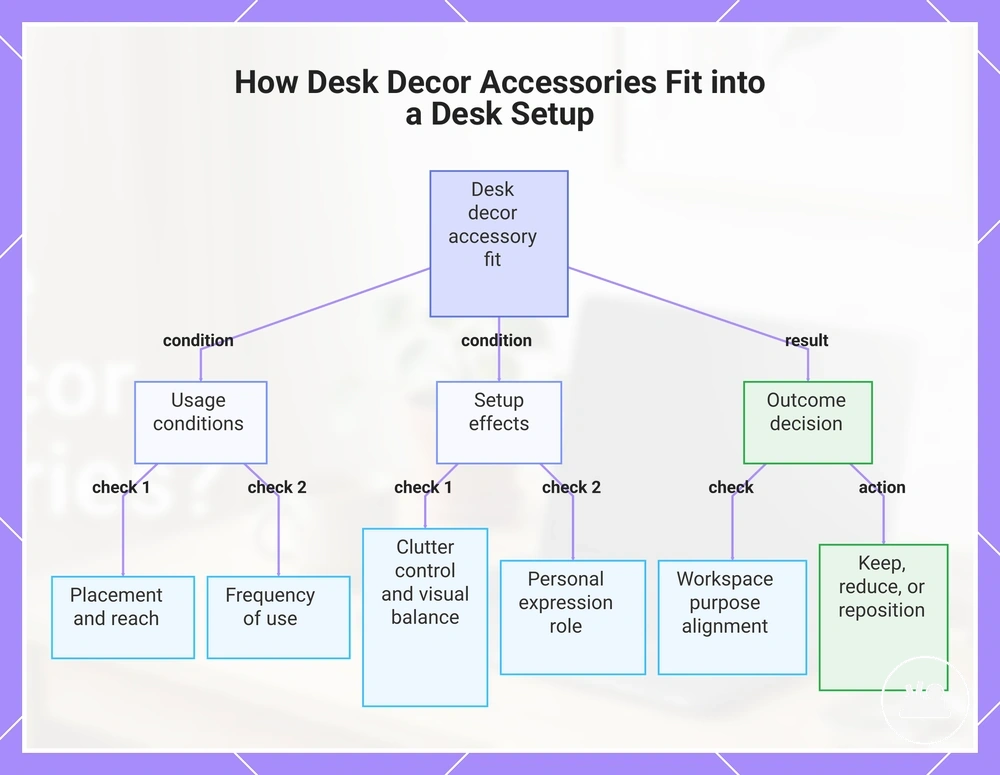
Desk decor accessories are desk-related items that combine visible presence, workspace support, and personal or functional value. They describe objects placed around a desk that contribute to both appearance and practical use within a workspace. The topic covers both appearance and desk relevance.
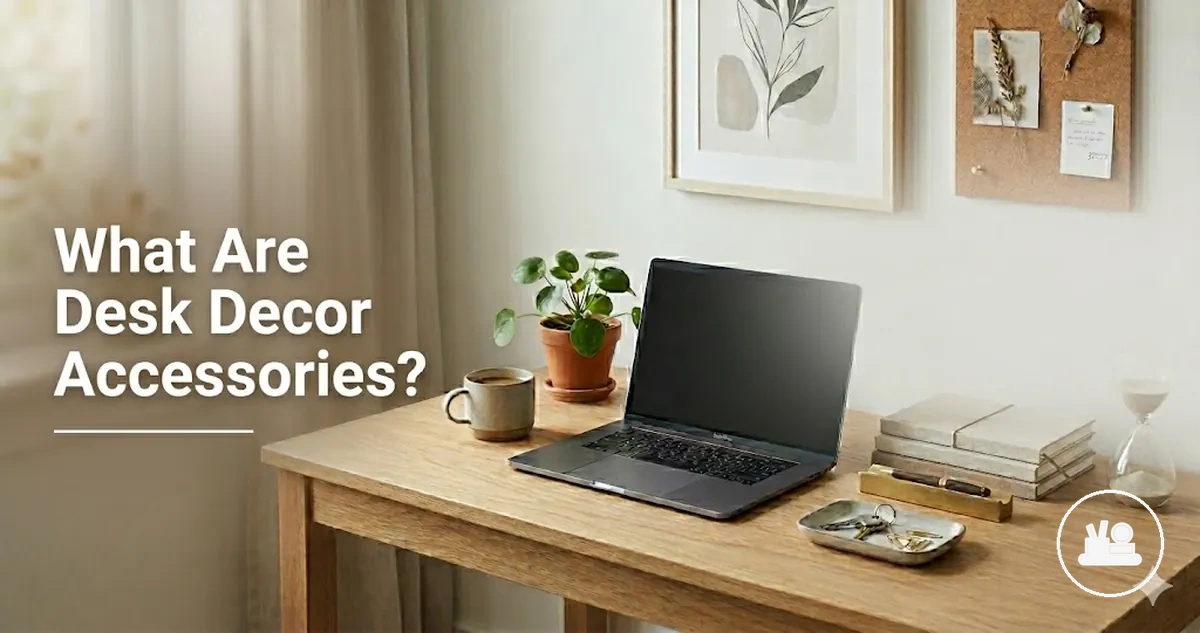
Desk decor accessories typically exist within the desk surface and nearby desk area, where they remain visible during everyday work activity. They may include elements that support organization, add decorative role, provide functional role, or reflect personal objects that shape the workspace setup. Their relevance depends on how they interact with the desk surface and how clearly they remain part of the working environment rather than unrelated surroundings.
The scope of desk decor accessories is not limited to a single category of items or a fixed set of objects. It includes anything that meaningfully contributes to the workspace through placement, visibility, and intent, as long as it stays connected to the desk setup. This boundary helps separate them from general items that exist in a room but do not directly relate to the desk area or its functional and visual structure.
What desk decor accessories mean
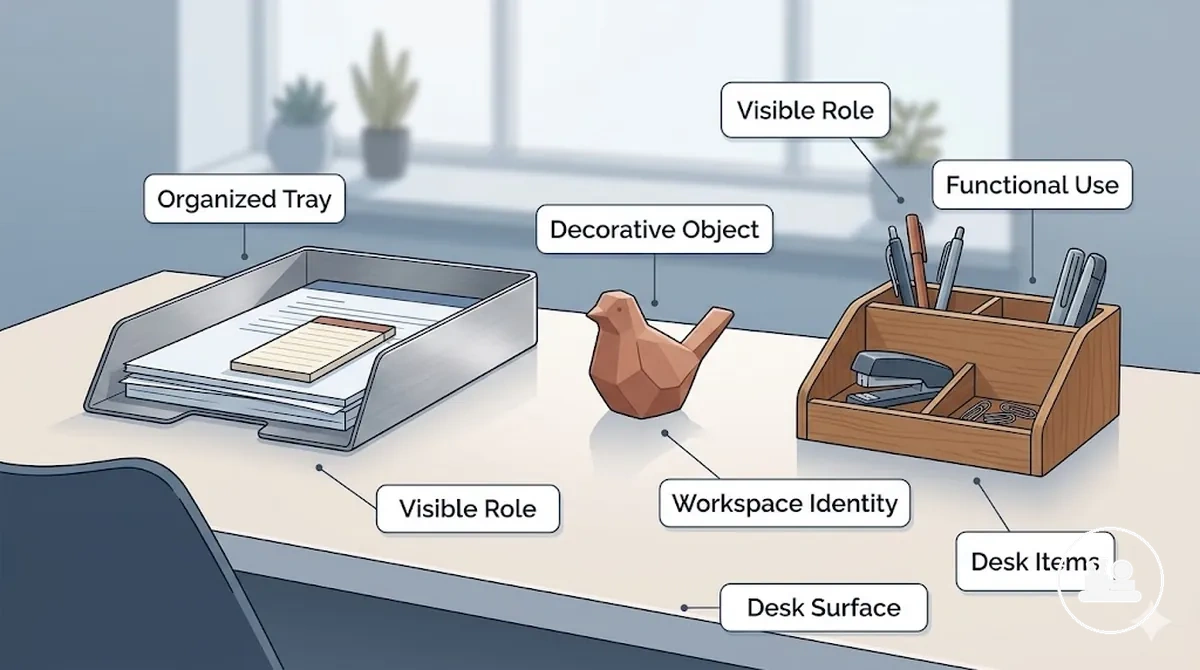
Desk decor accessories are items used around a desk to support appearance, organization, comfort, and workspace identity. These items remain connected to the desk environment through their visible role and placement on or near the desk surface. Their meaning stays tied to how they interact with the desk rather than existing as general room objects.
Desk decor accessories are items known as desk decor accessories that shape visible role of a desk area through appearance, organization, comfort, and workspace identity. The image below shows how desk decor accessories relate to desk surface placement and visible items in a structured setup.
They contribute to how a workspace is perceived by combining decorative and functional roles without turning the desk into a purely decorative space. Their use depends on whether an item supports desk-related intent such as structure or visual identity. A plain office supply used only for utility may fall outside this meaning when it does not create a visible or intentional desk-related presence.
What counts as desk decor on a workspace
Items count as desk decor on a workspace when they are visible in the desk area and contribute to workspace look, order, mood, or usability. The classification depends on placement and role, meaning the item must be clearly connected to how the desktop or nearby workspace is experienced.
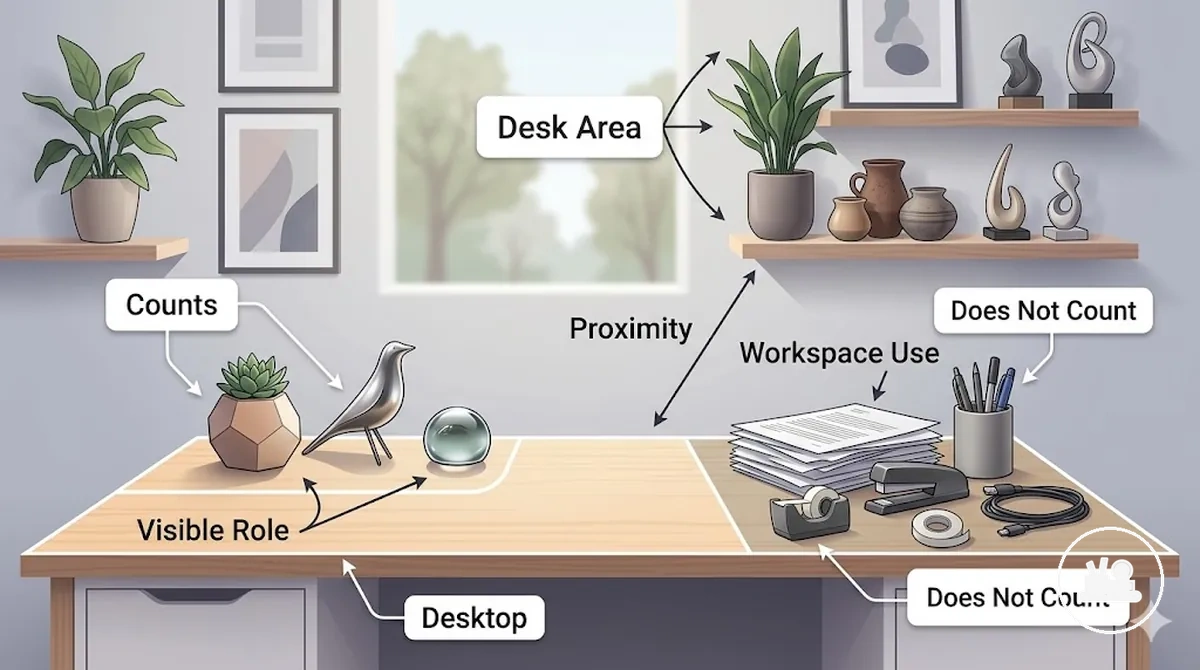
What counts as desk decor on a workspace is determined by visible presence in the desk area and how the item contributes to practical support, visual contribution, or personal expression. Items on the desktop usually qualify when they affect how the workspace functions or looks, while nearby items may also count when they remain closely tied to the desk setup. A limiting condition applies when objects are physically near the desk but do not influence its use or visual structure, in which case they fall outside desk decor classification.
What counts as desk decor on a workspace becomes clearer when checking observable criteria tied to placement and role. The checklist below helps evaluate whether an item belongs to desk decor based on its connection to the workspace.
- Visible within desk area
- Clear desk proximity
- Supports workspace look
- Provides practical support
- Reflects personal expression
- Maintains desk relevance
- Influences desktop setup
Desk items that belong on the work surface
Desk items that belong on the work surface are visible items placed directly on the work surface that support function, organization, or visual balance in the desk setup. These items usually stay within easy reach and relate to how the desktop is used in daily work. :contentReference[oaicite:0]{index=0}
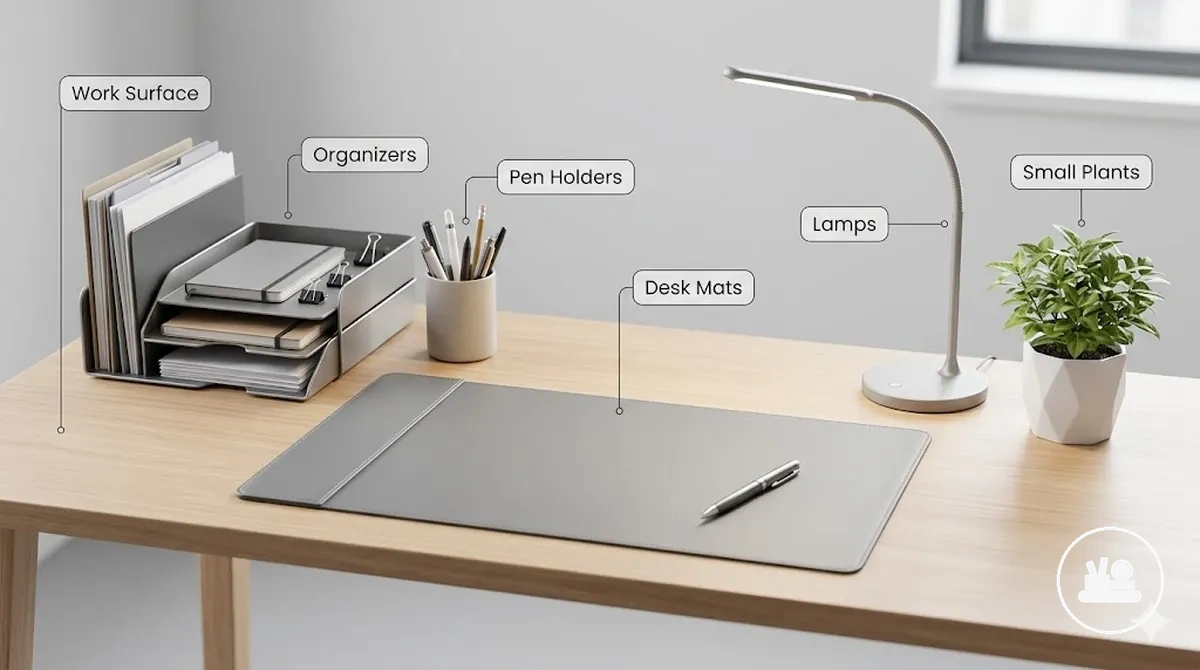
Desk items that belong on the work surface are typically chosen based on placement and practical role, where each object contributes to access, structure, or visual clarity without overcrowding the desktop. Their usefulness depends on how they support active desk use and how naturally they fit into the working layout.
The main examples of desk items that belong on the work surface include:
- Organizers for structured storage
- Pen holders for quick access
- Trays for grouping small items
- Desk mats for surface support
- Lamps for focused lighting
- Small plants for visual balance
Desk-area items that support the setup
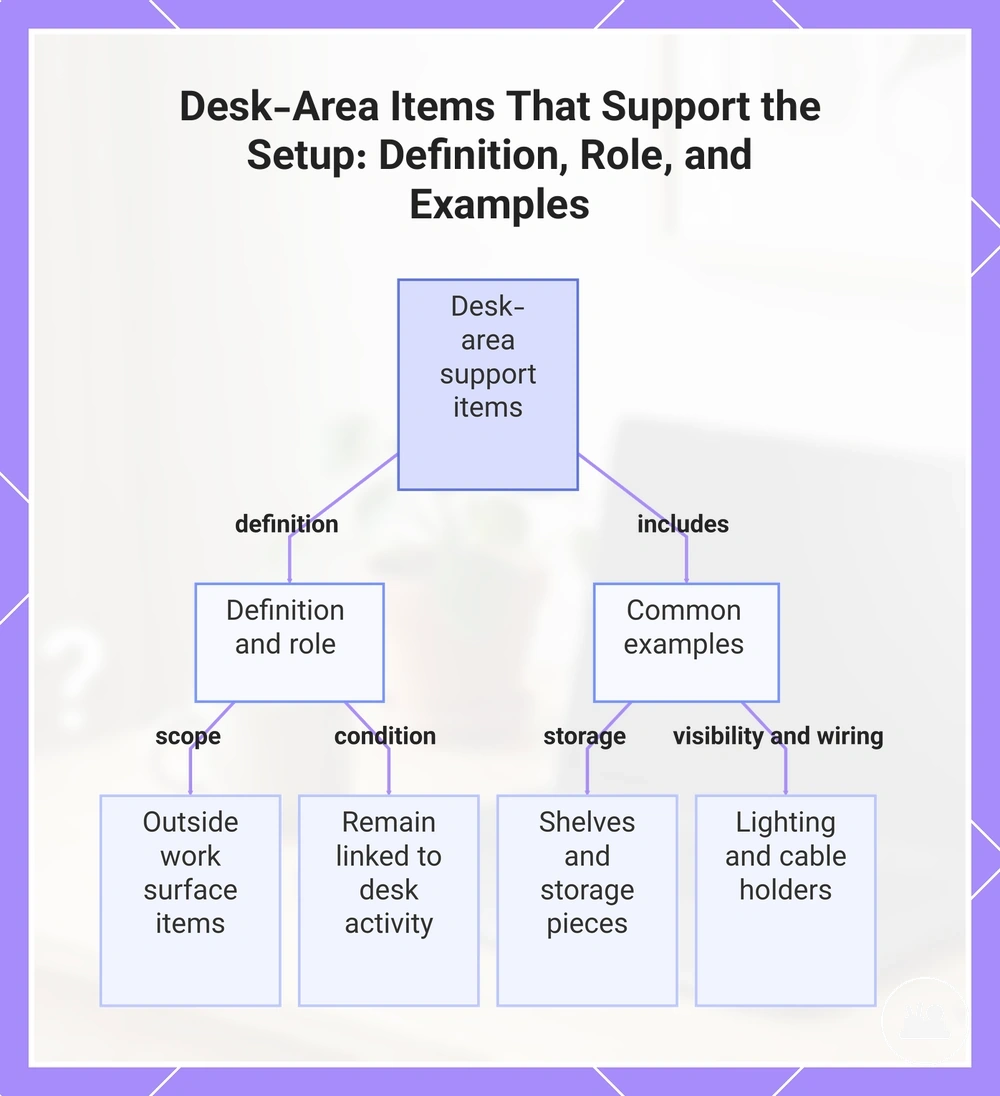
Desk-area items that support the setup are desk-area items in the nearby desk area that support the overall setup through proximity, function, and workflow continuity. These items stay outside the work surface but remain connected to how the setup operates when their placement aligns with desk use needs.
Their role depends on whether they still contribute to the setup without becoming general room elements, which means they must remain clearly linked to desk activity through support, lighting, cable holders, or storage pieces. When this connection weakens, they no longer function as desk-focused support items.
Desk-area items that support the setup can include:
- Small shelves that provide nearby storage
- Lighting positioned to support desk visibility
- Cable holders that organize workspace wiring
- Storage pieces that keep desk tools accessible
This chart defines desk-area support items, their condition for remaining functional, and common examples.
Desk decor accessories vs general desk accessories
Desk decor accessories are judged by both visual contribution and desk relevance, while general desk accessories are typically defined by purely functional use. The distinction is conditional rather than absolute, and overlap is common depending on intent and context of use.
The comparison depends on functional role, visual contribution, placement, and user intent. Items may be classified as decorative, functional, or hybrid based on how they are used in the workspace. This creates flexible boundaries where a single object can shift between categories depending on purpose and presentation.
| Item angle | Desk decor accessories | General desk accessories | Boundary note |
|---|---|---|---|
| Visual role | Supports visual contribution to workspace setup | Minimal focus on appearance | Overlap occurs when design is intentional |
| Function | Hybrid functional and decorative use | Primarily functional use | Function alone does not define category |
| Placement | Placed for visible presence in setup | Placed for practical access | Placement can shift classification |
| User intent | Intent includes aesthetic and desk relevance | Intent focused on task efficiency | Intent strongly influences category |
| Hybrid overlap | Common in real setups | Can still carry visual presence | Categories often intersect |
This distinction is closely aligned with functional vs decorative desk accessories, where classification depends on how functional and visual roles are balanced within the setup.
Common examples of desk decor accessories
Common examples of desk decor accessories are representative categories that help identify how desk decor accessories appear in real workspace setups through visual contribution and desk relevance. These examples are not a complete inventory but grouped patterns that show how different desk decor accessories support storage, usability, comfort, and personal expression. :contentReference[oaicite:0]{index=0}
Examples become clearer when grouped by desk role rather than listed as individual items. This approach highlights how each group connects to the desk setup through function, visual balance, or user intent, while avoiding a rigid or exhaustive classification of items.
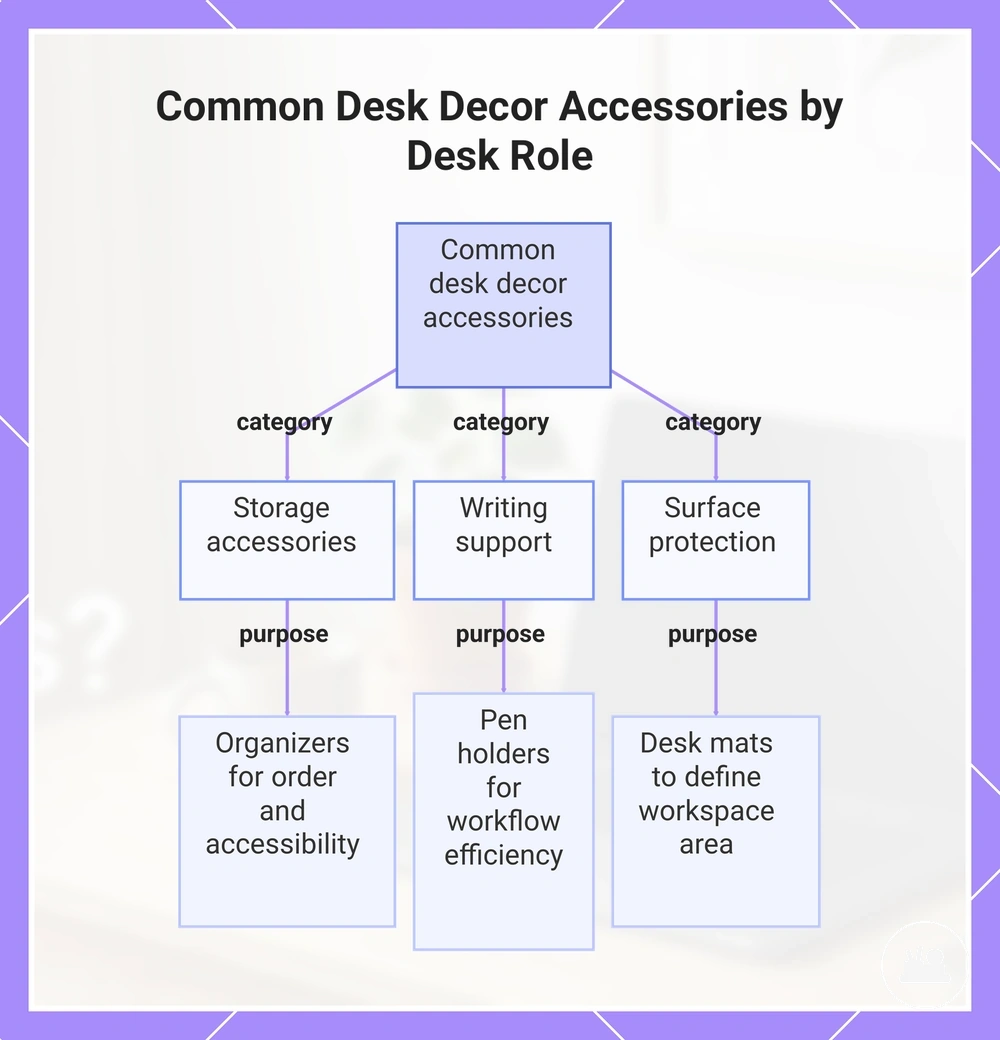
Common examples grouped by desk role include:
- Storage – organizers and containers that support order and accessibility within the desk setup
- Writing support – pen holders and related tools that improve access and workflow efficiency
- Surface protection – desk mats and pads that help define and structure the workspace area
- Lighting – desk lamps that support visibility and task-focused use
- Decorative accents – small visual elements that contribute to visual contribution and workspace identity
- Personal objects – items that reflect user preference while maintaining desk relevance
- Comfort items – accessories that support usability and working comfort in the setup
This grouping helps position desk decor accessories within broader category understanding such as main types of desk decor accessories, where each category is explored in a more structured breakdown.
This chart shows representative groups of desk decor accessories, each supporting a specific function in the workspace.
Organizers, trays, holders, and desk mats
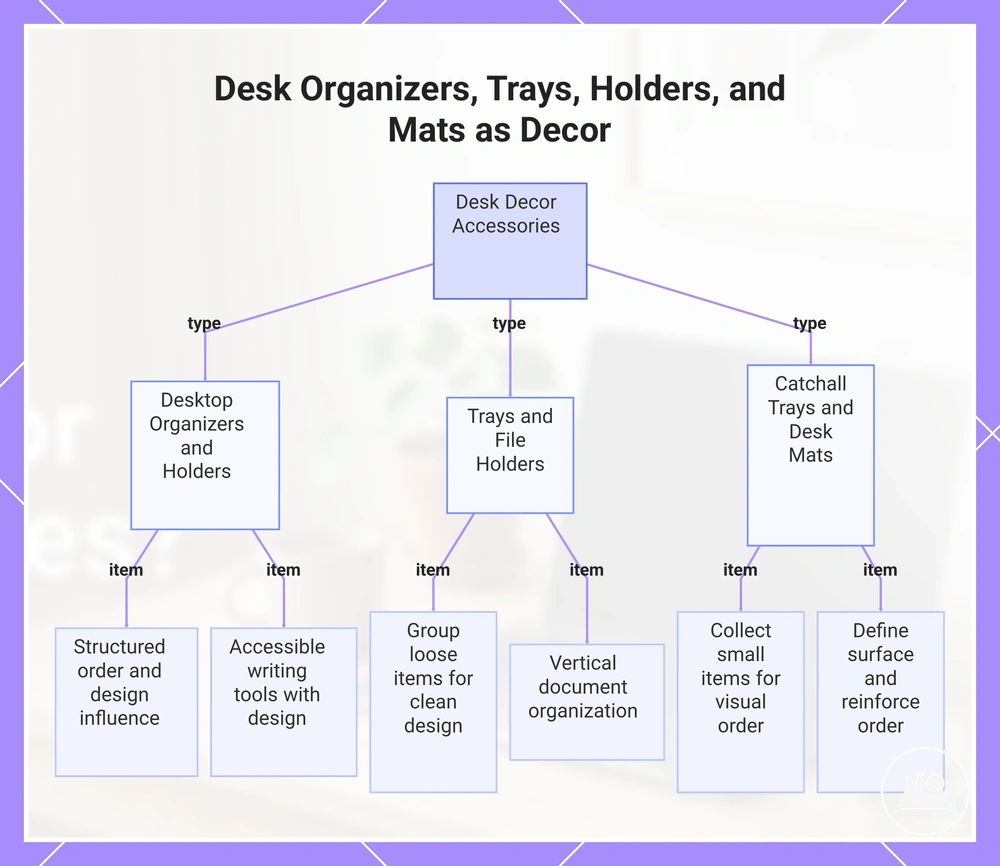
Organizers, trays, holders, and desk mats are functional desk items that can qualify as desk decor accessories when their visible design, finish, or placement contributes to both order and visible design in the workspace. These items connect order with visible design, making them relevant to desk decor relevance when used within the desk setup context. :contentReference[oaicite:0]{index=0}
- Desktop organizers – support structured order for small items while their visible design can influence the overall workspace appearance depending on placement and finish
- Trays – group loose items into a defined surface area, supporting order while also contributing to a cleaner visible design on the desk
- Holders – include pen holders and pencil cups that keep writing tools accessible while adding visible design elements to the desk surface
- File holders – organize documents vertically or in sections, supporting order and contributing to structured desk decor relevance when placed visibly
- Catchall trays – collect small items in one place, combining functional order with a clear surface-level visual structure
- Desk mats – define the working surface while adding visual structure and reinforcing workspace order through surface coverage and placement
This chart shows the categories of desk organizers, trays, holders, and mats that qualify as desk decor accessories by combining functional order with visible design.
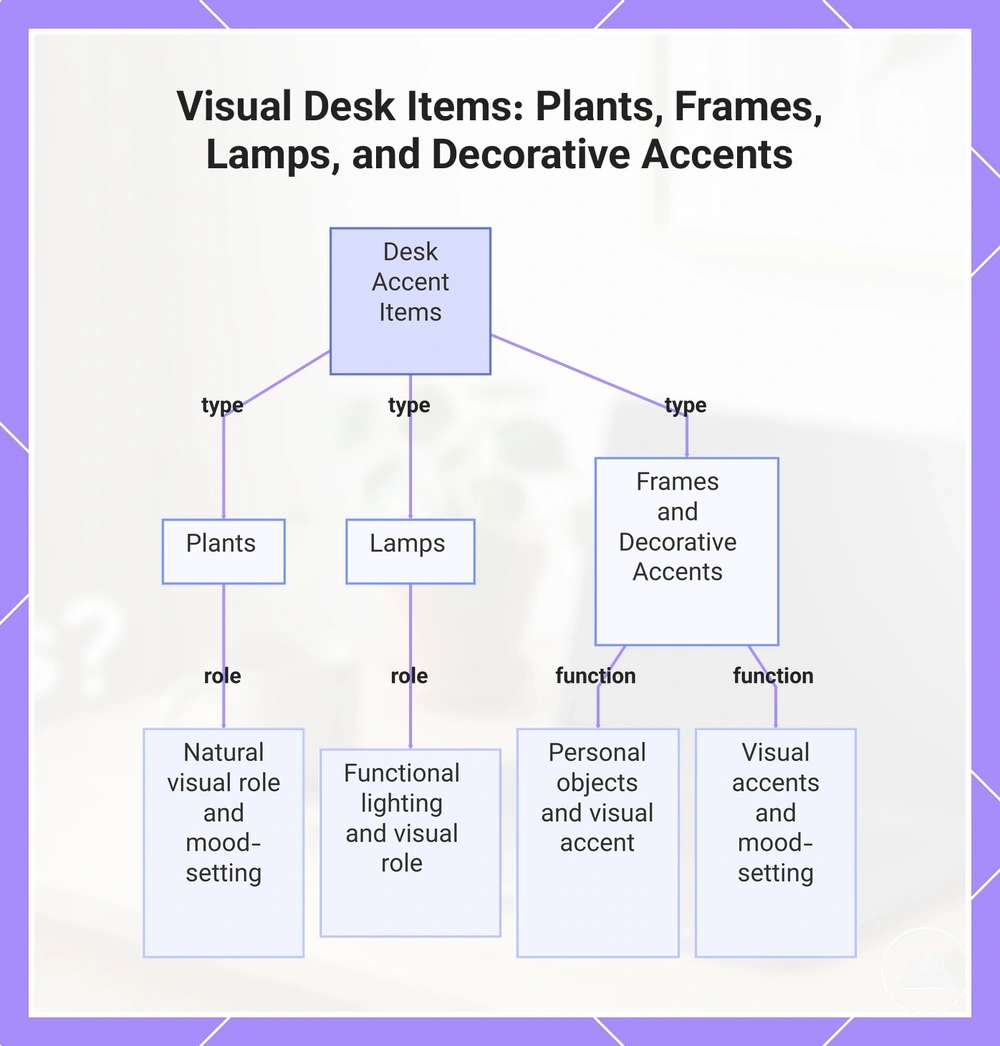
Plants, frames, lamps, and decorative accents
Plants, frames, lamps, and decorative accents are visual desk items that support a workspace through visual role and mood-setting when they remain proportional and desk-relevant. These items function as plants, frames, lamps, and decorative accents that add a controlled layer of personal objects and visual accents without overpowering the desk setup. Their effectiveness depends on maintaining proportional balance within the workspace.
- Plants – small plants that introduce a natural visual role and mood-setting element while staying desk-relevant in size and placement
- Frames – framed photos or mini art that provide a personal objects layer and visual accent within a limited desk footprint
- Lamps – desk lamps that combine functional lighting with visual role, supporting a balanced and desk-relevant setup
- Decorative accents – small sculptures, vases, or clocks that contribute visual accents and mood-setting when kept proportional
This chart shows the main categories of visual desk accent items and their specific functions within a workspace.
How function and appearance define desk decor accessories
Desk decor accessories are defined through the combined attributes of function and appearance, where usefulness, visibility, design, placement, and workspace fit work together to shape classification. These attributes determine how an item behaves in a desk environment and how it visually integrates with the workspace, linking practical role and visual role in a single evaluation frame.
Key attributes include accessory type, function, appearance, size, material, color, finish, and placement. Function and appearance interact through usefulness and visibility, while design and placement influence how strongly an item fits the workspace. Size, material, color, and finish affect surface expression and visual consistency, but classification still depends on combined context rather than any single attribute. No single attribute always decides whether an item qualifies as a desk decor accessory.
In hybrid cases, an item such as a desk lamp or organizer may serve a clear practical role while also contributing visible design to the workspace. In such situations, classification may shift depending on how strongly function and appearance align in the specific setup. The distinction is better understood through structured criteria such as desk decor accessory attributes.
This chart shows how desk decor accessories are defined through the combined interaction of function and appearance, and how classification depends on context rather than a single attribute.
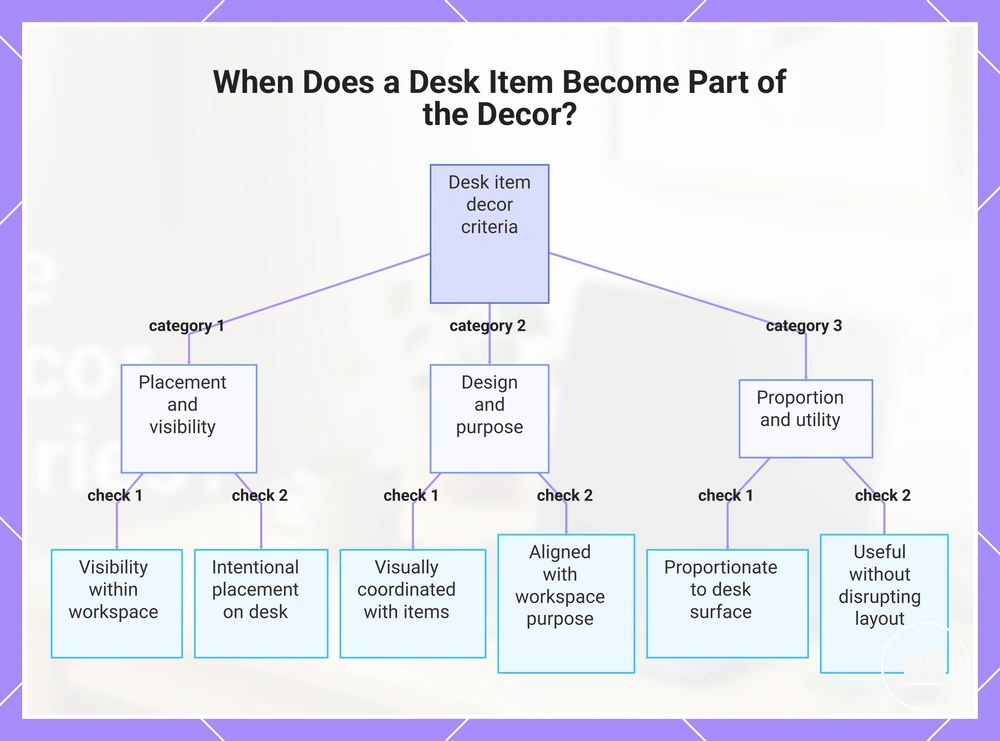
When a desk item becomes part of the decor
A desk item becomes part of the decor when its visibility, placement, and design intention affect how the workspace looks or feels. This depends on context rather than a fixed rule, so the same item may qualify as decor in one setup and remain purely functional in another.
Items such as chargers, mugs, notebooks, or storage boxes may become part of the decor when they are visibly placed, intentionally positioned, and visually coordinated within the workspace. When they are proportionate to the desk and aligned with the workspace purpose, they contribute to the overall presentation. If they are hidden, randomly placed, or not integrated into the setup, they typically remain outside the decor role.
When a desk item becomes part of the decor can be checked using these criteria:
- Visibility within the workspace setup
- Intentional placement on or near the desk
- Visually coordinated with surrounding items
- Useful to the desk without disrupting layout
- Proportionate to the desk surface
- Aligned with workspace purpose
- Clear presentation within the desk context
This chart groups the key criteria that determine whether a desk item transitions from purely functional to part of the workspace decor.
How desk decor accessories fit into a desk setup
How desk decor accessories fit into a desk setup depends on how they interact with surface space, placement, and daily work use. Their role is shaped by how they sit within the desk setup rather than existing as separate objects, and this fit changes based on context and usage patterns.
Fit is influenced by surface space, work habits, reach, and visual balance across the working area. Items used frequently usually stay within easy reach, while less-used pieces may shift toward the edges of the setup. Clutter control and visual balance determine whether accessories support or overload the desk setup, and the decision often comes down to whether each item should be kept, reduced, or repositioned based on workspace purpose.
How desk decor accessories fit into a desk setup can be reviewed through a set of usage conditions and setup effects. The checklist organizes these factors based on how placement, reach, frequency of use, clutter control, visual balance, personal expression, and workspace purpose interact in a real desk setup.
- Placement within accessible reach
- Reach during daily work habits
- Frequency of use in the desk setup
- Clutter control impact on layout
- Contribution to visual balance
- Role in personal expression
- Alignment with workspace purpose
- Keep, reduce, or reposition decision
In practical use, desk decor accessories integrate into a desk setup based on how these conditions shape their placement and overall fit.
:contentReference[oaicite:0]{index=0}
This chart shows the main factors that determine how desk decor accessories integrate into a desk setup, including usage conditions, setup effects, and the resulting decision to keep, reduce, or reposition items.